
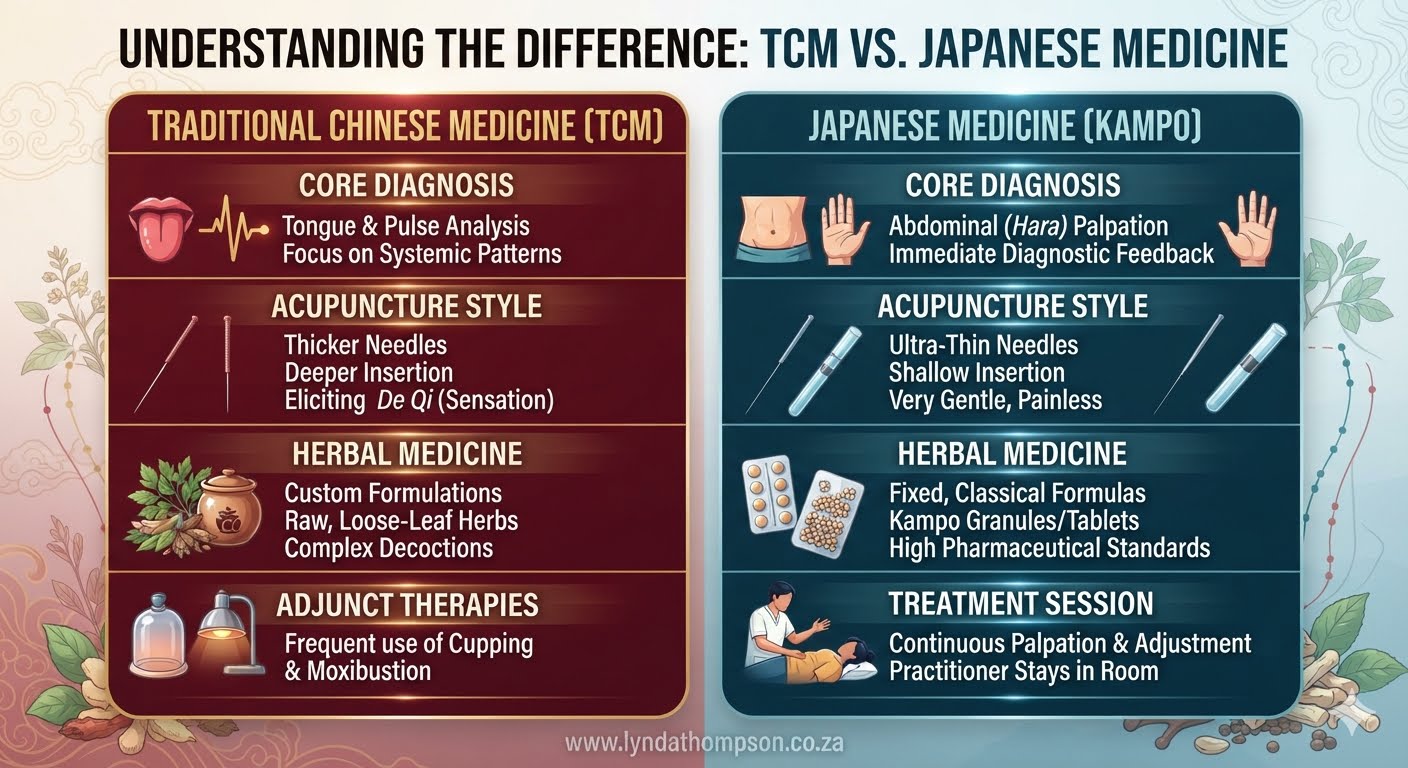
While TCM remains rooted in broad, philosophical systems of dialectical pattern differentiation, Japanese medicine has streamlined these theories into a highly practical, palpation-heavy, and tactile style of healthcare.
1. Acupuncture Technique: Gentle Precision vs. Deep Sensation
The physical experience of receiving acupuncture varies significantly between these two regional traditions.
- TCM Acupuncture: Practitioners traditionally use thicker needles inserted deeper into the tissue. The explicit goal is to elicit De Qi, a distinct, heavy, tingling, or dull aching sensation indicating that the nervous system and metabolic energy have been successfully stimulated.
- Japanese Acupuncture: This style uses ultra-thin needles guided by thin insertion tubes (a Japanese innovation). Insertion is incredibly shallow, sometimes merely touching the surface of the skin. The stimulation is exceptionally gentle, making it an ideal choice for children, the elderly, or highly sensitive patients.
2. Diagnostic Focus: The Tongue vs. The Abdomen (Hara)
Both systems evaluate your health holistically, but they collect their physical evidence from entirely different parts of the body.
- TCM Diagnosis: A practitioner focuses heavily on looking at the tongue (its colour, shape, and coating) and reading the radial pulse. This information is synthesized into abstract syndromes like “Liver Qi Stagnation” or “Spleen Qi Deficiency with Damp”.
- Japanese Diagnosis: The primary diagnostic tool is abdominal palpation, known as Hara diagnosis. The practitioner gently presses different zones of your abdomen to feel for tightness, temperature changes, or tenderness. Point selection is adjusted in real-time based on how your abdomen reacts to the touch.
3. Herbal Medicine: Custom Decoctions vs. Standardized Kampo
Herbal medicine showcases the sharpest divergence in clinical philosophy and manufacturing standards.
- TCM Herbalism: Treatments are highly customised. A doctor writes a bespoke raw formula of 10 to 15 herbs, which the patient boils down into a pungent, liquid tea (decoction). The recipe is altered at every visit to match the patient’s shifting symptoms. Popular decoctions are also available in tablet form.
- Japanese Kampo: Kampo is highly standardised and fully integrated into the modern Japanese biomedical healthcare system. Instead of changing the formula, practitioners prescribe fixed, historically proven classical combinations manufactured under strict pharmaceutical Good Manufacturing Practices (GMP). They are easily taken as pre-packaged, concentrated granules or tablets.
4. Practitioner Presence and Session Style
The atmosphere and flow of your clinical treatment session look quite different under each discipline.
- TCM Style: The needles are inserted, and the practitioner may leave you to rest in a quiet room for 20 minutes while the needles do their work. Adjunct therapies like Cupping Therapy or heat lamps are frequently used alongside the needles.
- Japanese Style: The practitioner typically remains in the room with you for the entire session. They constantly monitor your pulse, re-palpate your Hara, and manually adjust or change needles as your body provides immediate, real-time feedback.
Quick Comparison Table
| Clinical Feature | Traditional Chinese Medicine (TCM) | Japanese Medicine / Kampo |
| Needle Thickness | Thicker, substantial gauge | Ultra-thin, hair-like |
| Insertion Depth | Deeper, targeting De Qi sensation | Shallow, gentle, surface-level |
| Core Diagnosis | Tongue and pulse analysis | Abdominal (Hara) palpation |
| Herbal Approach | Custom, loose-leaf raw decoctions | Fixed, standardized GMP extracts |
| Clinical Theory | Broad philosophical frameworks | Pragmatic, anatomy-focused |
At our Blouberg practice, we focus on identifying the exact roots of your systemic imbalances to tailor a path to recovery that respects your body’s unique sensitivities. Dr Lynda is trained in TCM, working in China, London and South Africa which is the base of her therapies but she has brought in some of the gentler Japanese techniques.
Ready to experience the restorative power of professional acupuncture? Book an appointment at our Table View clinic today.
Book Appointment
Let us help you shift your body out of stress and into its natural state of healing.